|
|||
|
|||
|
|||
|
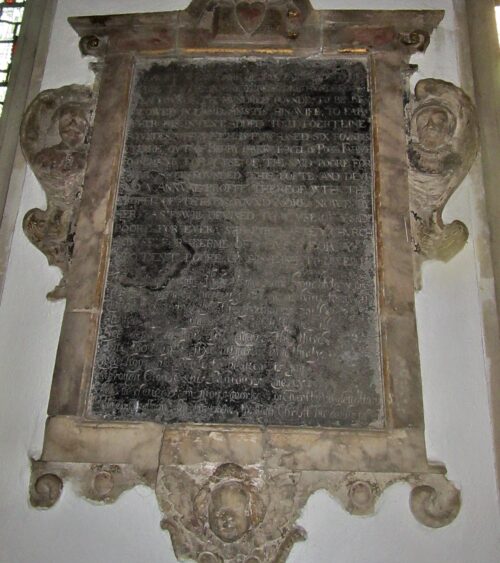
D.O.M.P.Q.
Mortalitatis Exuvias hic deposuit
THOMAS STRODE
Serviens ad Legem; Qui in Christo
placidè
obdormivit
Feb: 4o. 1698.
Ætat.: suae 70.
Vir Immortali Memoriæ sacratus; Jurisprudentiâ,
pietate, & Consilio, Insignis;
Moribus Integris Juxta ac Suavissimis: Deo, Principi &
amicis semper fidus:
Patre
JOHANE STRODE Equite Aurato de Parnham in
Comitatu Dorset
oriundus;
Charissmam
sibi adscîvit Conjugem
MARIAM ADAMS relic:
de PARKINSON ODBER
Armigero;
Ex quâ filiam suscepit unicam adhue superstitem.
Quæ hoc supræmu: pietatis Monument:,
Mœsstissima & cum lacrymis gemens,
L.M.D.P.Q. |
|||
|
To God the Greatest and Best and to Posterity
Thomas Strode, Sergeant at Law, who quietly fell asleep
in Christ on
February 4 1698, at the
age of 70, here deposited the remains of
mortality.
He was a man consecrated to undying memory:
distinguished by knowledge of the law, piety and wisdom:
uniting in his character both integrity and great
sweetness; ever faithful to God, Prince and friends.
Born of a father, Sir John Strode of Parnham in the
County of Dorset he took to his most dear wife Mary
Adams, the widow of Parkinson Odber, Gent, who bore him
one daughter as yet living, who most sorrowful and
groaning with tears as a last act of piety this
[well-deserved] monument willingly ordered and
placed. |
|||
|
The question that needs to be addressed is who made
this imposing monument? It is clearly a very high
quality piece and probably a metropolitan product.
Thomas Strode and his brother Sir George
Strode, also a Sergeant at Law, were the executors
of Sir Hugh Wyndam, died 1684 and whose large
monument, erected in 1692 can be seen at Silton,
also in Dorset. The Wyndham monument is unsigned but
is the work of John Nost (died August 1710) while
that at Sherbourne Abbey to John Digby, Earl of
Bristol who died in 1698 is signed by Nost and is
the only monument to bear his signature. It can be
assumed that as executors of Sir Hugh’s estate they
may well have been involved in the contract for the
monument and therefore knew of Nost. |
|||
|
Beaminster is approximately half way between Silton and
Sherbourne and there is more than a passing similarity
between the Strode monument and the other two. |
|||
|
|||
| In the Silton monument the left foot of Sir Hugh is projecting forward and at an angle and the right hand holds a scroll so as to give balance to the figure. Precisely this arrangement is repeated on the figure to Thomas Strode while at Sherbourne the Earl holds a coronet in his right hand and the left foot is slightly forward but balanced by the left hand resting on the hip. The treatment of the wig is identical on the Beaminster and Sherbourne figures. The drapery above the heads is very similar in all three examples and the monuments are all made of fine white marble. | |||
|
Architecturally, the Wyndham and Digby monuments are
clearly similar, the former having barley twist columns
to support the superstructure but the coffered soffit,
square capitals and, lower down, Corinthian capitals are
the same in both examples. However, this is not so
surprising when we realise that Rachel, second daughter
of Sir Hugh Wyndham by his first wife Jane Wodehouse,
was the second wife of John Digby and became Countess of
Bristol in August 1663. The inference is that it was
Rachel who was responsible for commissioning Nost to
produce the monument to her husband, having seen at
first hand the quality of his work in the monument to
her father. The Strode monument uses pilasters to
support the canopy. The floral decoration seen on the
Digby and Wyndham monuments is absent on the Strode
piece and the weeping putti are, like those seen on the
Digby piece, much more conventional in their treatment
unlike the Wyndham examples where the weepers are almost
life sized.
All three monuments make use of black backgrounds. The
Digby example is flat while Wyndham and Strode stand
within black marble niches, the former on a raised
gadrooned plinth upon which the weepers are seated. |
|||
| Nost has only five works attributed to him in the Biographical Dictionary of British Sculptors (Roscoe, Hardy and Sullivan 2009) but his principal business activity was in the production of lead garden statues. The Spencer monument at Yarnton in Oxfordshire (1684) is also firmly attributed to Nost as is that at Wanstead, Essex to Sir Joshua Child (1699) and it appears that one of his trademarks is the pose he uses for his principal figures marked by a projecting left foot. There is increasing evidence to suggest that Nost produced more monuments than currently ascribed to him and from the evidence it can be said that the Strode monument at Beaminster is one of them. | |||
|
|
|||
|
Dr Clive J Easter |