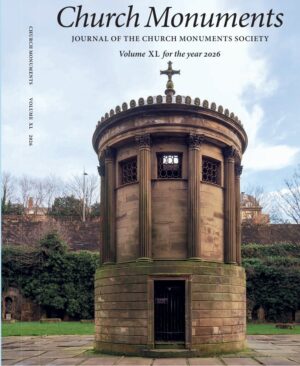
The background to a medieval military effigy, the development of the fashion for kneeling figures on tomb chests, polychrome on a royal effigy, some gruesome charnel carvings, detailed study of some Baroque monuments, the chequered history of a politician’s monument, and a wide range of book reviews.
The Journal is free to members. If you are not a member - to whet your appetite, these are the articles: click the buttons below to read the abstracts and order a copy.
NIGEL TRINGHAM
The monument of Ralph, Lord Basset (d. 1390), formerly in Lichfield Cathedral 9-25
MADELEINE GRAY
Kneeling weepers on medieval tomb chests and monumental brasses 26-50
CHRISTINE BUCKLEY with ANN J. ADAMS
The effigy of King John (d. 1216), Worcester Cathedral: evidence for its polychromy 51-97
ROGER BOWDLER
‘A Golgotha of Skulls and Bones’: charnel monuments of the Caroline period 98-131
ELISE PHILIPPE
Documenting the Mérode-d’Allamont commemorative monument: new archival and typological perspectives 132-164
ANNA FAIRLEY NIELSSON
The Huskisson Monument, Liverpool: The biography of a nineteenth-century memorial 165-181
The monument of Ralph, Lord Basset (d. 1390), formerly in Lichfield Cathedral
A native of Staffordshire, Ralph Basset was still only a boy when he succeeded his grandfather as Lord Basset in 1343. From the 1350s he embarked on a military career, serving on royal campaigns mainly in France, and was elected a Knight of the Garter in the late 1360s. Both his marriages were childless, and in the years up to his death in his mid-fifties in 1390 Ralph was concerned with choosing someone who would take his name and arms. No one did, and his only memorial was his monument in Lichfield Cathedral. Prominently sited close to St Chad’s shrine, the monument bore his effigy in full armour and displayed armorial shields reflecting his family lineage and military companions. Damaged by Parliamentary forces in 1643, the monument can be reconstructed from contemporary descriptions and drawings, although some aspects remain uncertain because of discrepancies between versions.
MADELEINE GRAY
Kneeling weepers on medieval tomb chests and monumental brasses
Kneeling ‘weepers’, usually represented as children of the deceased, are a regular feature on sixteenth-and seventeenth-century tomb chests. They are much less common on medieval monuments, but they do exist, and the earlier examples may suggest possible origins for the style. There are several surviving monumental brasses with kneeling children, either depicted praying for the souls of their parents or venerating a sacred image. Figures on tomb chests are more varied: there are depictions of children kneeling before sacred images, but also single adult figures and groups of figures, and monuments with a combination of kneeling and standing figures. Some earlier examples have books or speech scrolls and may represent the Hours of the Dead or the liturgy for the commendation of the soul. By the early sixteenth century kneeling weepers were more common, some simply rows of children, others in more complex designs. The Reformation put an end to veneration of images and prayer for the soul, but kneeling weepers retained their popularity, now depicted as the family at prayer.
CHRISTINE BUCKLEY with ANN J. ADAMS
The effigy of King John (d. 1216), Worcester Cathedral: evidence for its polychromy
The effigy of King John (d. 1216) in Worcester Cathedral, the oldest effigy to a monarch in England, is made of Purbeck marble. It appears to have been wholly polychromed and gilded, which is unusual for a material valued for its ability to take a high polish. This article explores the evidence for this, the impact of the passage of time including active interventions and, in particular, the influence of the early nineteenth-century etchings of Charles Alfred Stothard (1786–1821) on the perception of the effigy and subsequent reproductions. The treatment of the effigy over the period also reveals the development of modern conservation practice.
ROGER BOWDLER
‘A Golgotha of Skulls and Bones’: charnel monuments of the Caroline period
In the decades before the outbreak of Civil War in 1642, the London masons’ workshop of the Christmas family produced a series of highly distinctive church monuments which are some of the most intense memento mori ever produced. They share a common feature of jumbled bones – as in a charnel house – set behind a grille, carved in alabaster in high relief. Taken together, they cast light on the circulation of imagery; on patterns of patronage; and on Anglican attitudes to the contemplation of mortality. The article also looks briefly at precedents for the symbol, and at other contemporaneous monuments which deployed this image.
ELISE PHILIPPE
Documenting the Mérode-d’Allamont commemorative monument: new archival and typological perspectives
The parish church of Ossogne (Belgium) houses two baroque funerary monuments that remain little known, as they have been overlooked by scholars. This paper offers an in-depth study of these monuments, based primarily on newly discovered archival documents and drawings. The result of the research allows for the confirmation of the attribution of the bas-reliefs to the Liège sculptor Jean Del Cour, as well as the establishment of a precise chronology for both their commission and execution and the identification of the commemorated individuals and their patrons. They also provide concrete insights into the practical aspects of their creation. The newly discovered drawings help to demonstrate that the bas-reliefs belong to an unusual commemorative typology, the commemorative altar. This study also explores the familial, propagandistic and especially spiritual dimensions of this typology, offering new insights into the motivations behind its creation.
ANNA FAIRLEY NIELSSON
The Huskisson Monument, Liverpool: The biography of a nineteenth-century memorial
William Huskisson (1770–1830) was a prominent statesman, financier and MP for Liverpool. The monument commemorating Huskisson at St James’s Cemetery in Liverpool is one of the most prominent nineteenth-century memorials in the city. Designed by John Foster Jr in the Greek Revival style and originally enclosing a marble sculpture by John Gibson, it was constructed as a focal point in the centre of the newly opened cemetery and quickly became a major landmark. In this article, the monument is studied as a memorial with an evolving biography. Since its erection in 1836, the monument has been subject to architectural criticism, alterations to the cemetery landscape, periods of neglect and restoration and more recently, debates concerning Huskisson’s political legacy. By tracing these developments, the article explores how commemorative monuments acquire new meanings over time and become embedded within the changing social and physical landscapes around them.
Order a past-printed publication
Click here for details on how to order back-issues of our journal from just £5 per volume (£7.50 for non-members).
We welcome contributions on a range of topics related to monuments and commemoration. Initial enquiries about substantial articles for possible publication in the Journal should be sent to the Editor. Shorter articles and news items can be published in the Newsletter. We also welcome less formal contributions for Monument of the Month and the Blog.
Additional guides on submissions, copyright and publishing online can be found in this section.