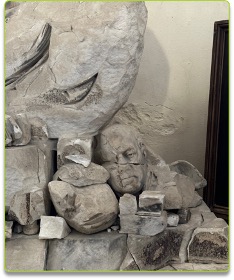
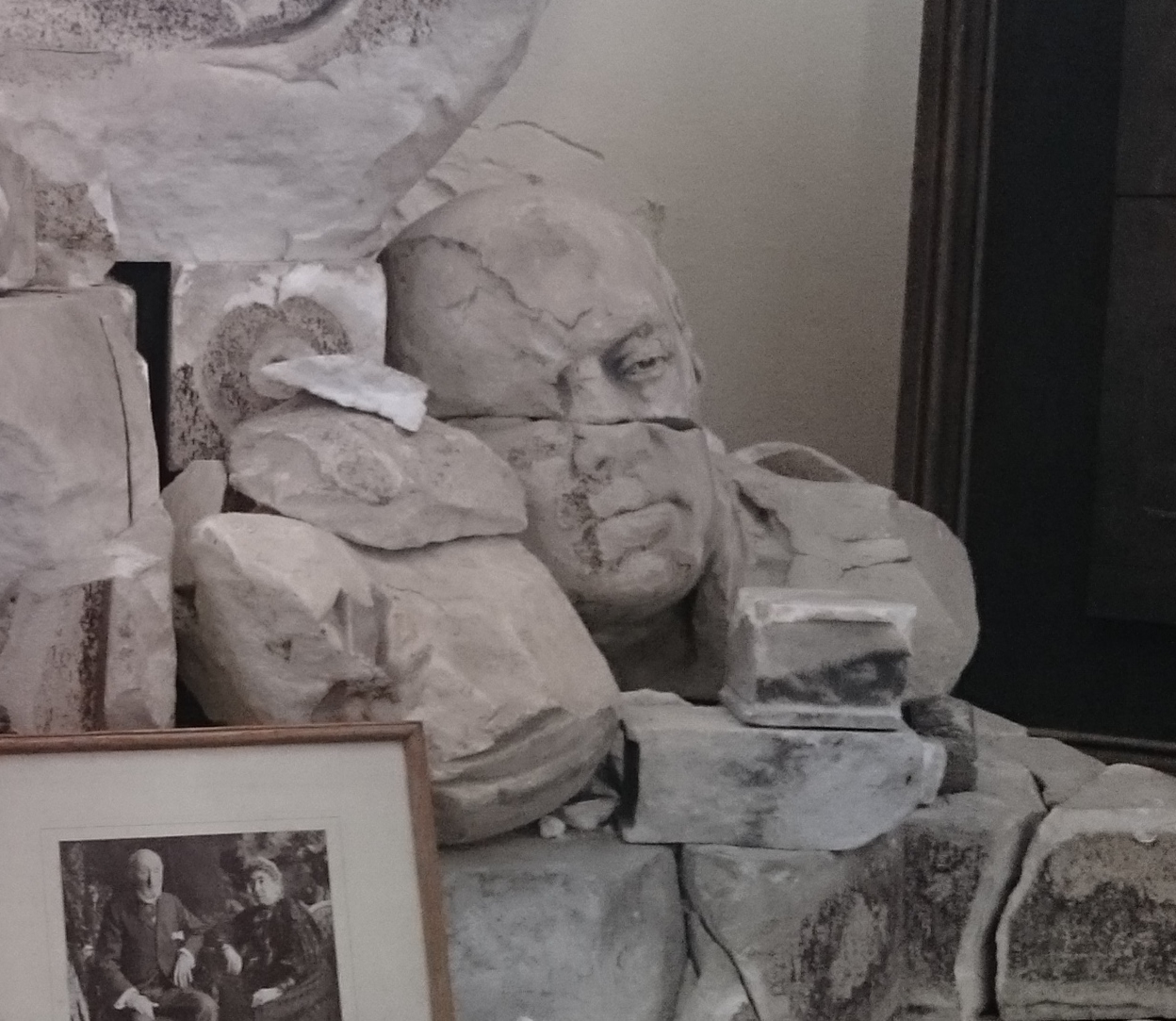
The ruined monument to Mariamne Johnes at Hafod
| Month: | October 2026 |
|---|---|
| Type: | Effigy |
| Era: | 19th Century |
Visit this monument
St Michael (Eglwys Newydd), Hafod
Pontarfynach, Ystrad Meurig SY25 6DX
| Month: | October 2026 |
|---|---|
| Type: | Effigy |
| Era: | 19th Century |
St Michael (Eglwys Newydd), Hafod
Pontarfynach, Ystrad Meurig SY25 6DX
These shattered fragments are all that remains of an imposing marble monument in the little parish church of St Michael, Hafod, in the hills to the east of Aberystwyth.
Thomas Johnes inherited the Hafod estate in 1780 and set about rebuilding the house and creating a Picturesque landscaped garden around it. He had plenty to work with – woods, rocks, little streams tumbling down into the Ystwyth river – but he developed these, creating caverns, waterfalls, wooded walks and viewing points. Partly to pay for this and partly in the interests of general estate improvement, he planted millions of trees: mainly conifers, but oak and beech on better ground. This also provided work for his tenants, and part of his estate improvement involved rebuilding their houses as well as his own. He also had a political career, serving successively as MP for the Cardigan Boroughs, Radnorshire and Cardiganshire – though he was oddly reluctant as an MP, saying that he ‘told my friends I thought I might be more useful to the county at Hafod than at Westminster’.
All this was expensive: his resources eventually ran out and in 1814 he was forced to put the estate up for sale. It was tied up for a while in Chancery before its purchase by the Duke of Newcastle in 1833. Like Johnes, he was a keen landscape designer and set about finishing some of Johnes’s incomplete projects.
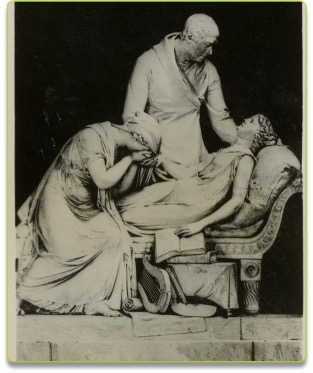
The monument to Mariamne Johnes: photo Richard Gaunt
The monument in Hafod church was one of these. Johnes and his wife Jane Johnes (she was his cousin) had a son who died very young and a daughter, Mariamne. Johnes was devoted to his daughter and named part of the gardens at Hafod after her. She seems to have suffered poor health and died unmarried in 1811. Heartbroken, Johnes commissioned the sculptor Francis Chantrey to produce a monument for her. The carving showed Mariamne on her deathbed: a book has just slipped from her hand. Her mother weeps at the foot of the couch while her grief-stricken father bends over her.
Unfortunately, the monument had still not been installed when Johnes was forced to leave Hafod, and it remained in the sculptor’s possession until 1840. The Duke of Newcastle may have felt he shared Johnes’s grief, since his own wife and three children had all died in 1822. (He himself commissioned Westmacott to provide a monument which can still be seen in the family mausoleum at Markham Clinton, Notts.) Soon after he acquired the estate, he paid Chantrey for the monument and had it brought to Hafod and installed in the church at a total cost of nearly £1,000. He recorded in his diary his delight at finishing the work and his admiration for the quality of Chantrey’s carving: ‘I have never seen any thing more beautiful both in design, feeling & finish’. Newcastle’s diary for his time at Hafod has recently been edited for the South Wales Record Society: Richard Gaunt, ‘This Princely Habitation’: The Hafod Estate under the 4th Duke of Newcastle, 1832-1846 (South Wales Record Society, 2025), https://southwalesrecordsociety.co.uk/product/this-princely-habitation-the-hafod-estate-under-the-4th-duke-of-newcastle-1832-1846/ .
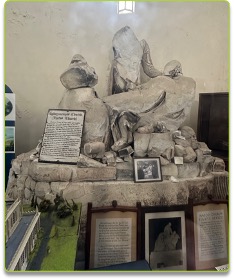
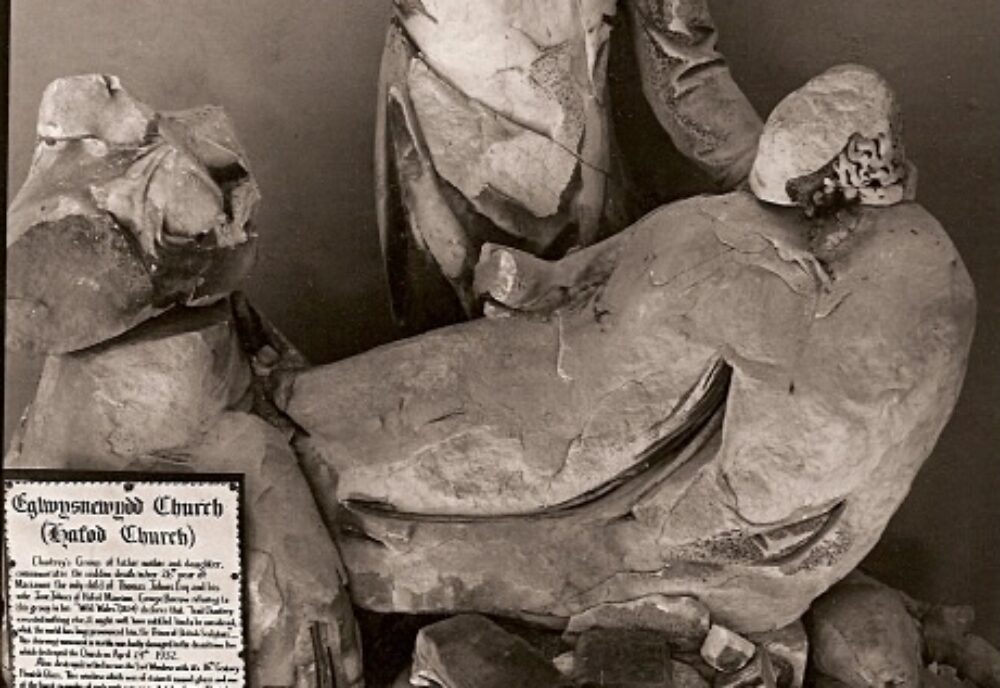
The Johnes monument after fire damage. Photo Richard Gaunt
The present state of the monument is the result of a disastrous fire in the church in 1932. As so often happens, the worst damage was done not by the fire but by the attempts to rescue the monument. When cold water from the hoses hit the hot marble, it shattered past repair. It remains in the church as a monument to a father’s grief and to the fellow feeling of an aristocrat who never knew Johnes personally. In some ways, its damaged condition renders it all the more powerful.
Madeleine Gray
Further reading
As well as Richard Gaunt’s edition of Newcastle’s diaries:
For a biography of Johnes see the History of Parliament, https://www.historyofparliamentonline.org/volume/1790-1820/member/johnes-thomas-1748-1816
and the Dictionary of Welsh Biography https://biography.wales/article/s-JOHN-THO-1748
The Hafod estate is now in the care of the National Trust https://www.nationaltrust.org.uk/visit/wales/hafod-estate
but was formerly in the care of the Hafod Trust https://hafod.org/homepage.html : their page on the church https://hafod.org/church.php has photographs of the damage done by the 1932 fire but some information may be out of date.
Finally, on the aesthetics of brokenness: an exhibition in Florence, ‘Broken: the Power of the Fragment’, reviewed in detail in the Guardian, ‘Stern, sensuous, almost kissable lips’: why sculptures can have far more power when they’re broken | Exhibitions | The Guardian