A monument in peril: the Lewys monument at Edington
| Month: | September 2026 |
|---|---|
| Type: | Chest tomb with canopy |
| Era: | 17th Century |
Visit this monument
Edington Priory Church
Monastery Rd, Edington, Westbury BA13 4QN
| Month: | September 2026 |
|---|---|
| Type: | Chest tomb with canopy |
| Era: | 17th Century |
Edington Priory Church
Monastery Rd, Edington, Westbury BA13 4QN
A gorgeous seventeenth-century monument in serious need of conservation
The Lewys monument in Edington church stood for some 300 years in the southeast corner of the chancel, but in the early twentieth-century it was moved to the southwest corner, where we see it today. It is probable that at the time of this relocation the various parts of this setting were fitted together using iron armatures. Inevitably, given the climatic conditions generally found in any church, these became corroded over time, so much so that the fabric of this setting is splintering and breaking up.
Edward Lewys was the eldest son of Sir Edward Lewis of Van, near Caerphilly; the family were at the time one of the most prominent of the landed gentry in Glamorgan. Lewys was knighted by James I in 1603, and was a gentleman of the Privy Chamber to Prince Henry and Charles I; he perhaps also had a military role. He married Lady Anne Sackville (1586-1664), the widow of Lord Beauchamp, sometime after 1618, with whom he had four sons and one daughter, all of whom are represented as weepers along the front of the tomb chest.
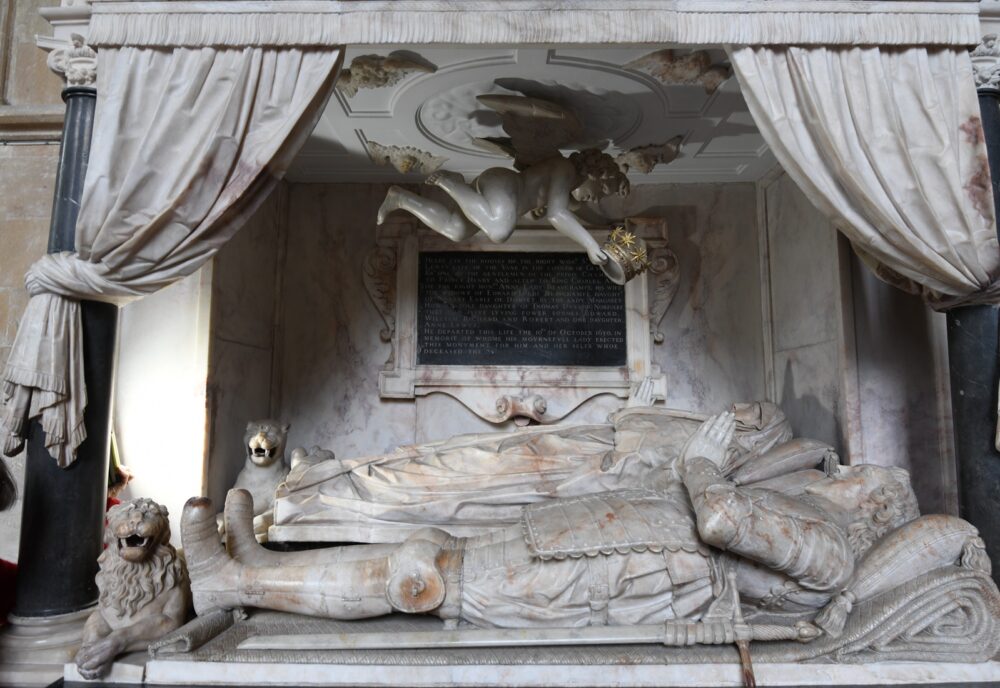
The effigies of the Lewis couple lie on woven rush mats, with plump pillows under their heads, within an enclosed space that has curtains drawn back, and looped around columns at each end, providing an illusion of a four-poster bedstead with the couple asleep within. Above them, hovers an oak-carved cherub offering a crown, symbolising an invitation to ascend to Heaven. Cherubs abound on this setting, with four winged-cherub heads carved on the ‘ceiling’ above the effigies, two more that stand on each corner above the entablature, holding shields perhaps deliberately positioned to provide a degree of degree of modesty, and a further cherub’s winged-head above the Lewys armorial in the attic.
The weepers are accompanied by a pair of angels, one praying for the souls of the departed, while the other is clearly weeping in mourning. Above the weepers a line of text offers a motto, ‘Since children are the living cornerstone / Where marriage built on both sides meets in one / While they survive our lives shall have extent / Upon record in them our monument’.
The carving detail is phenomenal, in particular the working of the armour worn by Sir Edward and his two older sons, seemingly with every clasp, buckle and hinge of the armour accurately depicted. Whilst this monument is largely carved from alabaster, it is surprising to discover that many parts of it are carved in wood, including the swords.
The quality of this monument clearly suggests a London tomb-maker, but who might this have been? Adam White has rejected the suggestions by Mrs K A Esdaile, who proposed Gerard Christmas and, alternatively, Edward Marshall (White 1999, 19 and 90). Julian Orbach, following Geoffrey Fisher, has put forward Maximilian Colt who, as Adam White points out, was Master Sculptor for James I, (Orbach 2021, 316; White 1999, 29-36).
This monument was repaired and restored by Miss Inger Norholt in 1966-7, from the end of August through to early January 1967. Her diary entries show that she refreshed the armorial tinctures with watercolour paints, and applied a coat of Kingston Translac, that she wrote would ‘pull out the colour sufficiently to prevent the shields from looking grey and dull in comparison with the newly cleaned and very handsome strawberry-jam-and cream alabaster’. Her work was admired by critics at the time.
As to its future, efforts are underway to stabilise this important monument, but as ever in these times, raising the considerable funds required for this work is difficult.
Nicholas Riall
Inger Norholt’s diaries, courtesy of her grandson, Mike Sedgwick.
Orbach, J, Pevsner, N, and Cherry, B. 2021, The Buildings of England: Wiltshire, Yale University Press, New Haven and London
White, A 1999, A Biographical Dictionary of London Tomb Sculptors c.1560 – c.1660, Walpole Society, 61, 1-162.
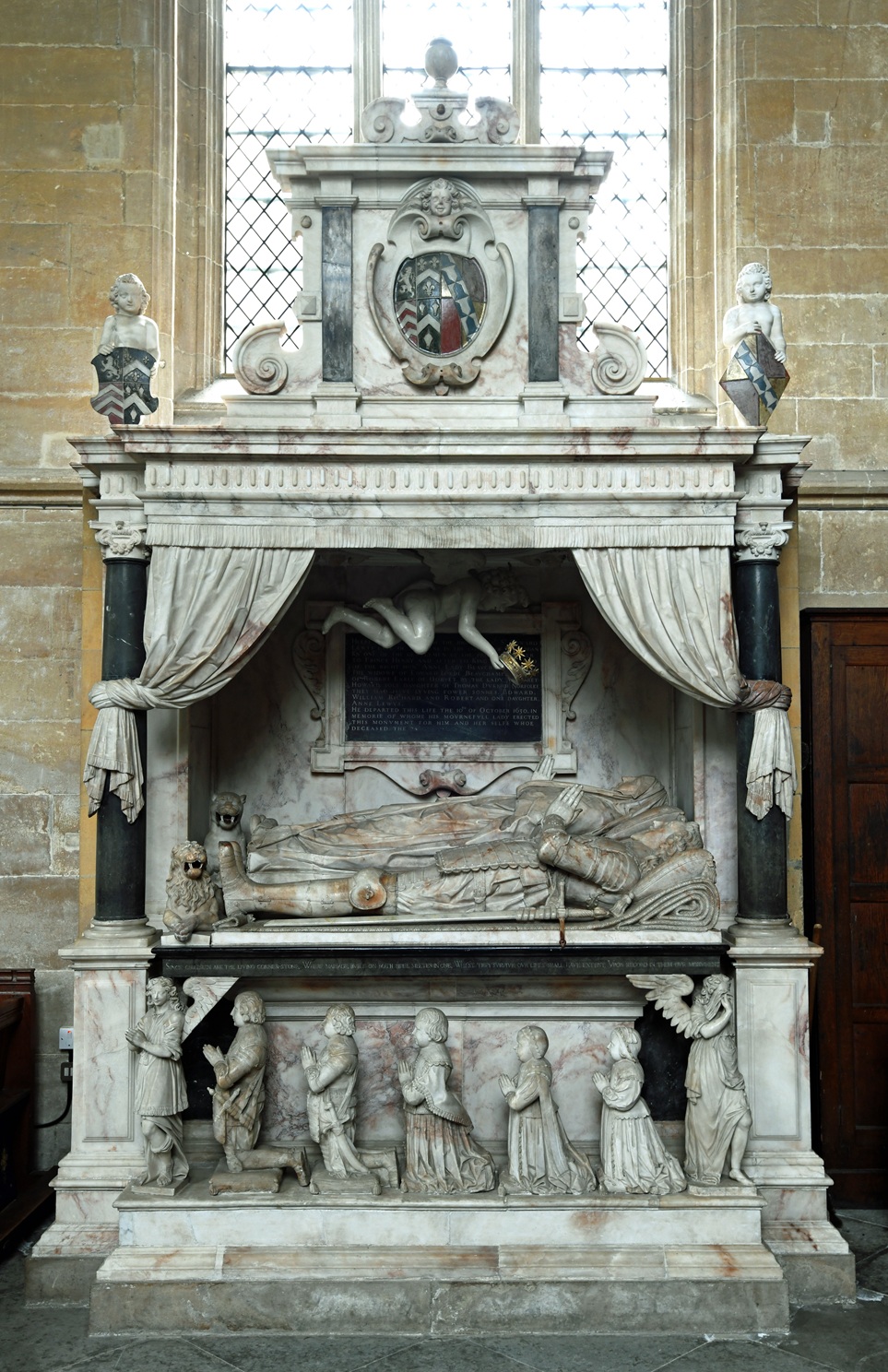 1 The Lewys monument in the chancel at Edington, Wiltshire from the north
 2 Almost like a stage set with the curtains drawn back to reveal the Lewys couple lying in state with lions at their feet
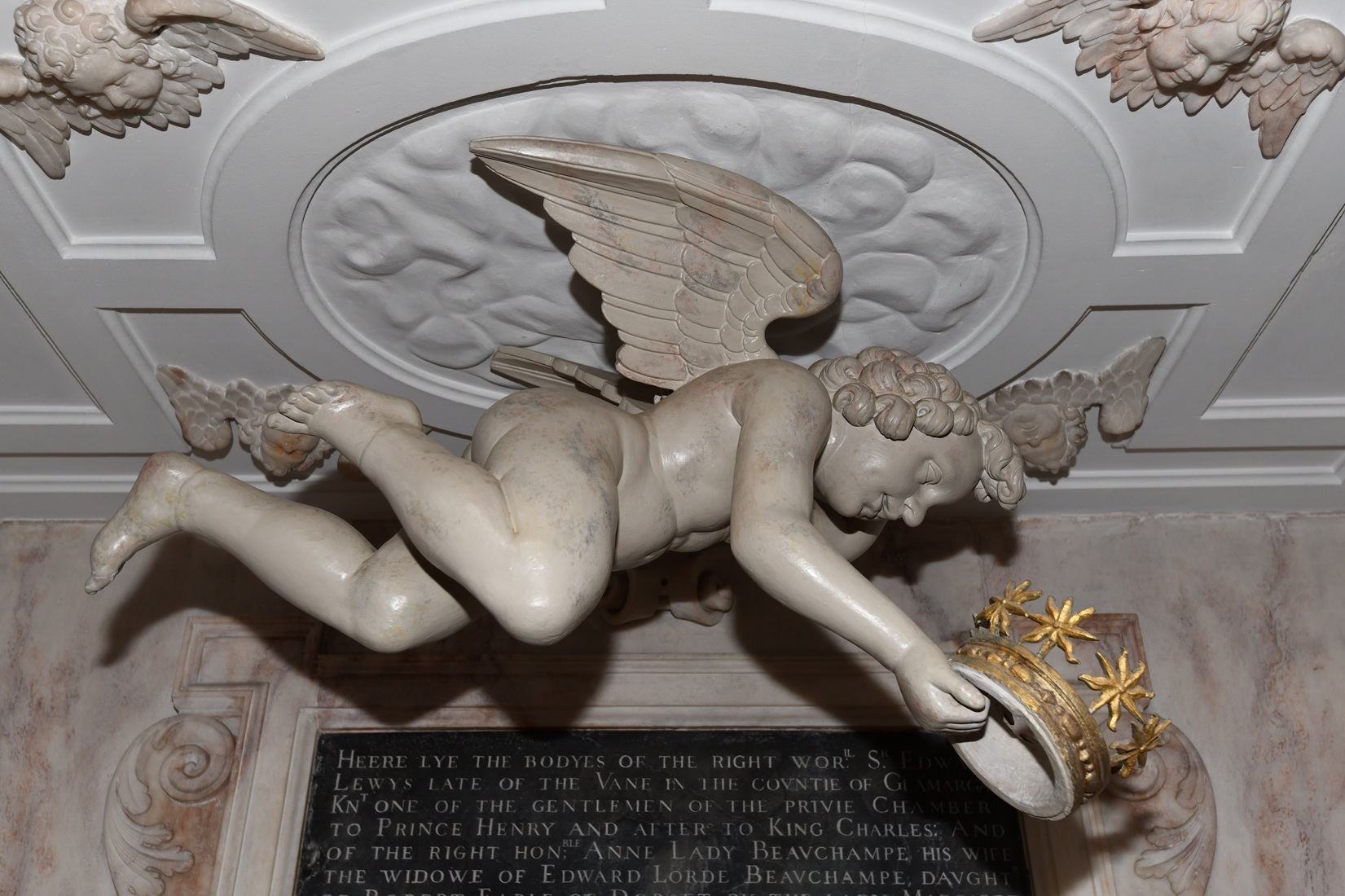 3 An angel hovers above holding out a Crown and pointing upwards to Heaven
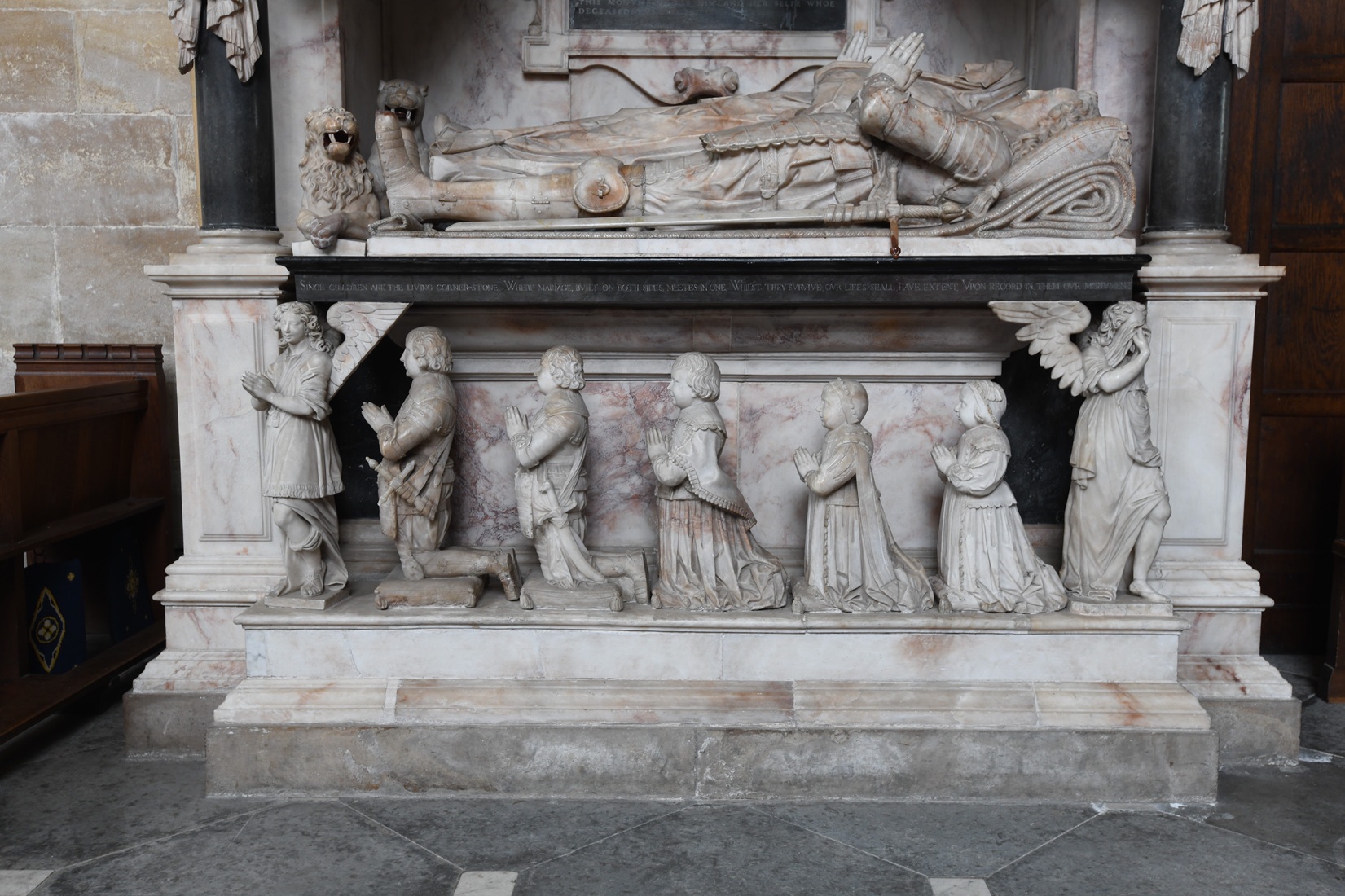 4 The Lewys children presented here as weepers, flanked at each end by angels.